
If you are looking for a unique summer salad, it is time to look further afield. The good news is that cuisines around the world offer dozens of vibrant summer salad recipes that most American backyards have never seen. These options offer a refreshing change of pace.
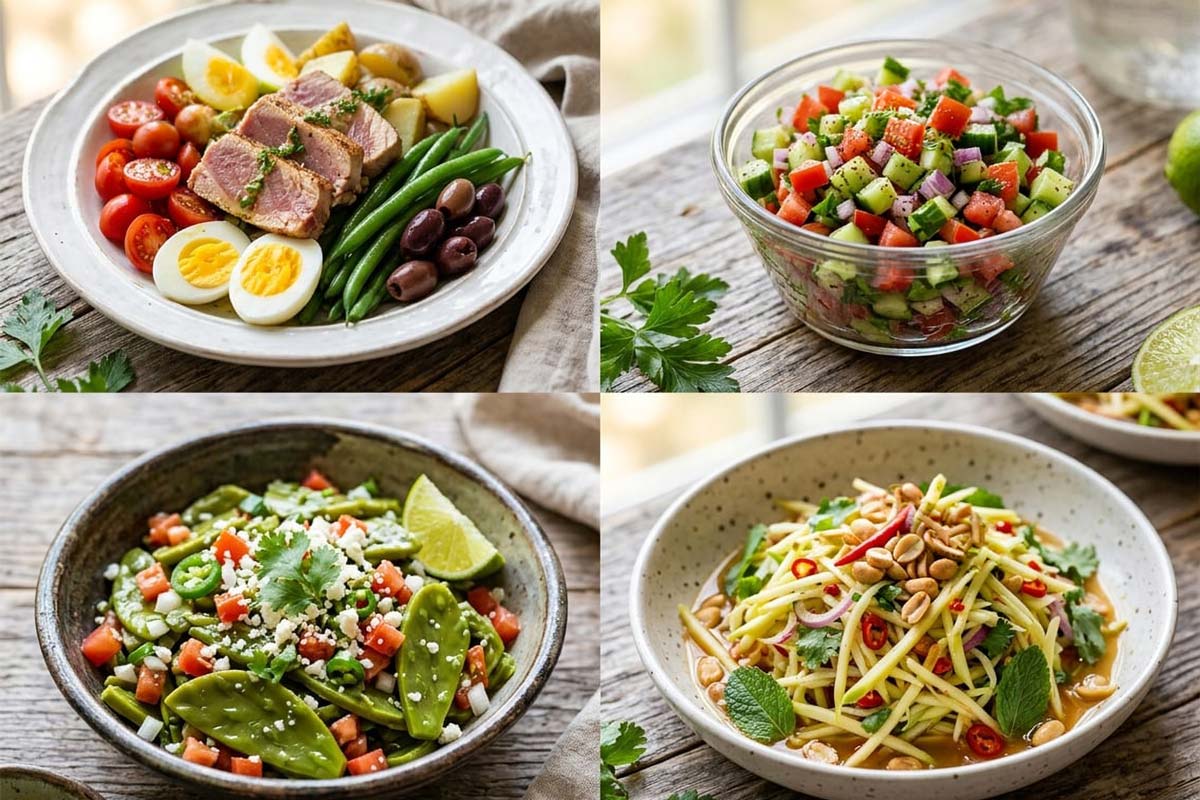
From the tart crunch of Thai green papaya to the smoky char of grilled Israeli vegetables, these are summer salads you have never heard of, and they belong at your next outdoor gathering. Each one brings bold flavors, holds up in warm weather, and gives your spread something people will actually remember. Some take fifteen minutes. Some use ingredients you already have. All of them are a serious upgrade from the usual rotation.
Consider this your cheat sheet for standing out at every barbecue, potluck, and patio dinner from now through September.
Table of Contents
- 1) Grilled Salade Niçoise
- 2) Som Tam
- 3) Kachumbari
- 4) Green Mango Salad
- 5) Korean Oi Muchim
- 6) Mexican Nopales Salad
- 7) Panzanella Salad With Grilled Peaches
- 8) Turkish Piyaz
- 9) Shirazi Salad
- 10) Israeli-Style Grilled Vegetable Salad
- What Makes A Summer Salad Feel New
- How To Pick The Right Salad For A Summer Gathering
- Frequently Asked Questions
1) Grilled Salade Niçoise
You probably know the classic French salade Niçoise: canned tuna, boiled potatoes, green beans, olives, and a vinaigrette. It is a staple of bistro menus everywhere. But throw a grill into the equation and the whole dish transforms into something smokier, bolder, and built for a cookout.
The traditional version dates back to Nice, France, where it has been a regional specialty since the early 1900s. Purists insist on raw vegetables and no cooked ingredients beyond eggs and anchovies, but the grilled interpretation plays by its own rules.
Quick Recipe:
- Brush fresh tuna steaks, halved potatoes, and trimmed green beans with olive oil, salt, pepper, and fresh herbs
- Grill the tuna about 2 minutes per side for a seared center; grill potatoes and green beans until charred and tender
- Arrange over butter lettuce with halved hard-boiled eggs, Niçoise olives, and cherry tomatoesD
- Drizzle with a Dijon vinaigrette made from olive oil, red wine vinegar, a spoonful of Dijon mustard, and minced shallot
The smoky char on the tuna and the crispy edges on the potatoes give this salad a depth you simply cannot get from the traditional preparation. It feels substantial enough to be a summer dinner salad that acts as a main course. This means you can skip the burger line entirely. The briny pop of Niçoise olives ties everything together with a salty, Mediterranean backbone.
Serve it on a big platter, family-style. People will crowd around it before the grill is even done.
2) Som Tam
If you have ever eaten at a Thai restaurant and spotted green papaya salad on the menu, you have met som tam. What you might not realize is how perfectly it fits a hot summer cookout. The flavors are loud, bright, and exactly what you want when it is 90 degrees outside.
Som tam originated in the Isan region of northeastern Thailand, where street vendors pound it together to order using a mortar and pestle. The dish has deep roots in Laotian cuisine as well, and it is considered one of the most popular street foods in all of Southeast Asia.
Quick Recipe:
Shred about 2 cups of green (unripe) papaya using a julienne peeler or the large holes of a box grater
In a mortar or bowl, lightly crush 2 garlic cloves and 1 to 2 Thai chilies
Add 1 tablespoon palm sugar, 2 tablespoons fish sauce, and the juice of 2 limes; stir until the sugar dissolves
Toss the shredded papaya with the dressing, a handful of halved cherry tomatoes, a few long beans or green beans cut into pieces, and crushed roasted peanuts
The flavor profile hits every note at once: sour from the lime, salty from the fish sauce, sweet from the palm sugar, and fiery from the chilies. That crunchy, tart papaya stays crisp even after dressing, so it holds up on a buffet table far better than leafy greens.
Make it as spicy or mild as your crowd can handle.
3) Kachumbari
Think of kachumbari as East Africa's answer to pico de gallo, but looser, brighter, and designed to be eaten as a proper salad rather than scooped onto chips. It is a staple across Kenya, Tanzania, and Uganda, served alongside grilled meats, stews, and rice dishes. At a cookout, it sits right next to whatever is coming off the grill and makes everything taste better.
The word "kachumbari" likely traces its roots to Indian influence in East African coastal cuisine, reflecting centuries of trade along the Swahili Coast.
Quick Recipe:
Dice 4 juicy tomatoes, 1 large red onion, and 1 jalapeño or serrano pepper
Toss with a generous handful of chopped fresh cilantro
Squeeze the juice of 2 limes over everything, add salt to taste, and mix gently
Let it sit for about 10 minutes so the flavors meld
The result is punchy, acidic, and refreshing. There is no oil, no cooking, and no fuss. These simple salad recipes rely on the quality of the produce. The raw red onion softens just slightly in the lime juice, and the tomatoes release enough liquid to create a natural dressing.
Kachumbari pairs beautifully with grilled chicken, steak, or sausages. Its simplicity is the whole point. You can prep it in under ten minutes, and it tastes like it belongs on a warm afternoon. If your cookout has any kind of spice lovers in the crowd, add an extra chili or two and watch it disappear first.
4) Green Mango Salad
Green mango salad is the kind of dish that stops people mid-bite and makes them ask what they are eating. It is popular across Southeast Asia, especially in Thailand, Vietnam, and the Philippines, where unripe mangoes are treated as a savory ingredient rather than a sweet snack. The firm, tart flesh of a green mango shreds beautifully and holds its crunch for hours.
In Thailand, this salad is sometimes called "yam mamuang" and is often served with grilled seafood. In the Philippines, a similar preparation goes by "ensaladang mangga."
Quick Recipe:
Peel and julienne 2 firm, unripe green mangoes
Toss with thinly sliced shallots, a handful of fresh mint and cilantro, and a sliced Thai chili
Whisk together 2 tablespoons fish sauce, 2 tablespoons lime juice, 1 tablespoon sugar, and a splash of rice vinegar
Pour the dressing over the mango mixture and top with crushed roasted peanuts
The flavor is aggressively tart and sour in the best possible way, balanced by the sweetness of the dressing and the herbal punch of fresh mint. The peanuts add a toasty richness that rounds everything out.
This salad is especially great next to grilled shrimp or fish. It cuts through fatty, smoky meats like nothing else on the table can. If you cannot find green mangoes at a regular grocery store, try an Asian market. They are usually easy to spot because of their rock-hard texture and bright green skin.
5) Korean Oi Muchim
Oi muchim is one of those side dishes that Korean home cooks throw together in minutes, yet it punches well above its weight in flavor. You will find it on nearly every Korean dinner table as part of the banchan spread, those small side dishes served alongside rice and a main course. At a summer cookout, it brings a cold, crunchy contrast to anything hot off the grill.
The name translates simply to "seasoned cucumber." It is a staple of Korean home cooking and is closely related to other quick kimchi-style preparations.
Quick Recipe:
Slice 3 to 4 Persian or English cucumbers into thin rounds or half-moons
Toss with 1 teaspoon salt and let sit for 10 minutes, then squeeze out excess water
Mix together 1 tablespoon gochugaru (Korean red pepper flakes), 1 teaspoon sesame oil, 1 teaspoon rice vinegar, 1 minced garlic clove, and a pinch of sugar
Toss the cucumbers in the dressing and finish with a sprinkle of toasted sesame seeds and sliced scallions
The salting step is key. It draws moisture out of the cucumbers so the dressing clings instead of pooling at the bottom of the bowl. What you get is a cool, spicy, garlicky bite with a satisfying crunch and a nutty sesame finish.
Oi muchim stays crisp even after sitting out for a while, which makes it ideal for outdoor eating. It pairs perfectly with grilled short ribs, burgers, or even hot dogs when you want to add something unexpected to the plate.
6) Mexican Nopales Salad
Nopales are the flat, paddle-shaped pads of the prickly pear cactus, and they have been a cornerstone of Mexican cuisine since long before European contact. Eating cactus might sound unusual, but the flavor is mild, slightly tangy, and reminiscent of green beans with a hint of lemon. Once you try nopales salad, the novelty fades fast and the craving takes over.
This salad, known as "ensalada de nopales," is especially common in central Mexico, where fresh cactus paddles are sold at virtually every market.
Quick Recipe:
Clean 3 to 4 fresh nopal paddles by trimming the edges and scraping off the thorns, then dice into small squares
Boil the diced nopales in salted water for about 8 to 10 minutes until tender; drain and rinse well to remove the slightly sticky texture
Toss with diced tomato, white onion, chopped cilantro, sliced jalapeño, and crumbled queso fresco
Dress with lime juice, a drizzle of olive oil, and salt to taste
The flavor profile is fresh, tangy, and herbaceous. The nopales have a pleasant, slightly tart quality that blends seamlessly with the tomato, lime, and cilantro. Queso fresco adds a mild, salty creaminess on top.
You can find fresh nopales at most Mexican grocery stores and many mainstream supermarkets in the Southwest and across much of the country. Jarred nopales work in a pinch, though fresh ones have a firmer texture. This salad keeps well in the refrigerator and actually tastes better after it sits for an hour, making it a smart make-ahead option for cookouts.
7) Panzanella Salad With Grilled Peaches
A traditional panzanella salad is a rustic Italian bread salad from Tuscany. It is traditionally made with stale bread soaked in juices from juicy tomatoes and vinegar. This vibrant summer salad uses the bread to soak up every drop of flavor. It was originally a clever way to use up day-old bread. Swap in grilled peaches and fresh strawberries alongside the tomatoes, and the whole dish shifts into something more exciting.
The first written references to panzanella date back to 16th-century Italian poetry, though the modern tomato version became popular much later.
Quick Recipe:
Tear half a loaf of crusty bread (ciabatta or sourdough) into rough chunks and toss with olive oil; grill or toast until golden and crunchy
Halve and pit 3 ripe peaches, brush with olive oil, and grill cut-side down for 2 to 3 minutes until char marks appear; slice into wedges
Combine the bread and peaches with halved cherry tomatoes, torn fresh basil, thin slices of red onion, and small chunks of fresh mozzarella
Dress with a simple mix of red wine vinegar and olive oil, or use a balsamic vinaigrette for a deeper flavor. Finish with a handful of fresh herbs like basil or mint.
The grilled peaches bring a caramelized sweetness that plays off the tangy tomatoes and the savory, chewy bread. Every bite has a different texture: crunchy, juicy, soft, chewy. Fresh basil ties it all together with an aromatic lift.
Let the salad sit for about 15 minutes before serving so the bread absorbs some of the juices without going completely soggy. This is the kind of dish that looks stunning on a platter and tastes even better than it looks.
8) Turkish Piyaz
Piyaz is a Turkish bean salad that manages to feel both hearty and refreshing at the same time. It is a great alternative to the usual pasta salads seen at barbecues. It comes from Antalya in southern Turkey, where it is traditionally served alongside a local specialty called "tahini kebab." The combination of tender beans, sharp onion, and a bright vinaigrette gives it a satisfying, almost meaty quality without any actual meat.
The dish is so closely tied to Antalya that it is sometimes called "Antalya piyazı" to distinguish it from other regional variations.
Quick Recipe:
Drain and rinse 2 cans of white beans (cannellini or navy beans work well) or use about 2 cups of home-cooked beans
Thinly slice 1 red onion and toss with the beans, chopped flat-leaf parsley, diced tomato, and a handful of sliced hard-boiled eggs
Whisk together 3 tablespoons olive oil, 2 tablespoons red wine vinegar, 1 teaspoon sumac, salt, and pepper
Dress the salad and toss gently; garnish with a sprinkle of extra sumac and a few black olives
Sumac is the star here. Its tart, almost lemony flavor gives the dressing a distinct brightness you cannot get from citrus alone. The beans are creamy and filling, and the parsley keeps everything tasting clean. Hard-boiled eggs add richness and protein.
Piyaz holds up incredibly well in warm weather because there are no leafy greens to wilt. You can make it hours ahead of your cookout and it only gets better as the beans soak up the dressing. It is the kind of protein-packed salad that works as a side or a light main for anyone skipping the burgers.
9) Shirazi Salad
Shirazi salad is named after the city of Shiraz in southern Iran, and it is one of the most common side dishes in Persian cuisine. You will find it at nearly every Iranian meal, from casual family dinners to elaborate holiday spreads. Its beauty lies in extreme simplicity: no cooking, no special equipment, and about five minutes of chopping.
Quick Recipe:
Finely dice 3 Persian cucumbers, 3 juicy tomatoes, and half a red onion into very small, uniform pieces. This chopped salad relies on the small dice for its signature texture.
Toss with 3 tablespoons fresh lime juice, 2 tablespoons extra-virgin olive oil, and salt to taste
Add 1 tablespoon dried mint (or a handful of fresh mint, finely chopped)
Mix well and let it rest for 5 to 10 minutes before serving
The flavor is clean, bright, and intensely refreshing. Lime juice does all the heavy lifting as the acid, and the dried mint adds an earthy, slightly sweet note that fresh mint alone cannot replicate. The tiny dice means every forkful has a balanced ratio of cucumber, tomato, and onion.
Shirazi salad is one of the best options for blazing hot days because it is cold, hydrating, and light on the stomach. It pairs naturally with grilled kebabs, rice dishes, and flatbread. The lack of any oil-heavy or creamy dressing means it will not weigh anyone down after a big meal.
If you want to add a subtle twist, a pinch of ground sumac scattered on top works beautifully. Keep it cold until the moment you set it out.
10) Israeli-Style Grilled Vegetable Salad
Grilled vegetable salads are common across the eastern Mediterranean, but the Israeli version stands out because of one key ingredient: tahini. Rather than a simple vinaigrette, a generous drizzle of lemony tahini sauce ties together the charred, smoky vegetables and turns them into something deeply satisfying.
This style of salad reflects the broader Middle Eastern and Mediterranean influence on Israeli cuisine, where grilling vegetables is a daily practice rather than a special occasion.
Quick Recipe:
Slice 2 zucchini lengthwise, halve 2 bell peppers and seed them, and cut 1 eggplant into thick rounds
Brush everything with olive oil, season with salt and pepper, and grill over medium-high heat until charred and tender, about 3 to 5 minutes per side
Chop the grilled vegetables into rough, bite-sized pieces and toss with chopped fresh parsley, a squeeze of lemon juice, and a pinch of cumin
Drizzle generously with tahini thinned with a little water and lemon juice; finish with a scattering of toasted pine nuts or pomegranate seeds if you have them
The smoky sweetness of charred eggplant and peppers, combined with the creamy, nutty tahini, creates a flavor that is rich without being heavy. The zucchini adds a tender bite, and the lemon keeps everything tasting vibrant.
This salad works at any temperature, which makes it flexible for cookouts. Serve it warm right off the grill, at room temperature an hour later, or cold from the fridge the next day. It holds up beautifully no matter what.
What Makes A Summer Salad Feel New
Unexpected Produce Choices
The fastest way to make a salad feel fresh is to reach for ingredients people do not expect. Green papaya, cactus paddles, strawberries, and grilled peaches all break the pattern. Using unexpected fruit in your summer salad can lead to amazing flavor combinations. It turns a simple dish into something memorable. When your starting ingredient surprises someone, the entire dish feels like a discovery. Look for seasonal produce at farmers markets or international grocery stores to find options that are not in the usual rotation.
Sweet-Savory Contrast
The most memorable summer salads play sweet against savory. Grilled peaches with torn bread and tangy vinegar. Watermelon with salty feta. Palm sugar balanced by fish sauce. That push and pull between sweetness and salt keeps your palate engaged and makes every bite interesting. A small amount of natural sweetness from fruit, roasted vegetables, or a touch of sugar in a dressing can lift a salad from ordinary to genuinely craveable.
Herbs, Acid, And Heat
Fresh herbs, a sharp acid, and a little heat form the backbone of almost every standout summer salad on this list. Think cilantro with lime, basil with red wine vinegar, or mint with lemon. Then add a chili, a pinch of gochugaru, or a few red pepper flakes. That trio of herbaceous freshness, bright acidity, and gentle burn is what makes a salad taste alive rather than flat. The specific herbs and acids change depending on the cuisine, but the principle stays the same. You can even use a herb-heavy green goddess dressing to provide that same punchy, fresh flavor profile to a variety of greens.
How To Pick The Right Salad For A Summer Gathering
Best For Outdoor Heat
When temperatures climb past 85 degrees, you need salads that will not wilt, separate, or turn mushy on a buffet table. Shirazi salad, kachumbari, and Korean oi muchim are your safest bets. They contain no leafy greens, no dairy-based dressings, and no ingredients that break down quickly. Grain-based salads and bean salads like Turkish piyaz also hold their structure for hours. Unlike a delicate pasta salad that might get oily or soggy, these maintain their bite in the sun. Keep everything in a cooler until serving time and you are set.
Best Make-Ahead Options
If you want to prep the night before and avoid morning stress, go with salads that actually improve after sitting. Turkish piyaz, Mexican nopales salad, and Shirazi salad all benefit from marinating time. The beans absorb dressing, the nopales mellow out, and the cucumbers and tomatoes release just enough juice to create a natural sauce. Panzanella is the exception: toast the bread and prep the other ingredients separately, then combine them 15 to 30 minutes before serving.
Best Crowd-Pleasing Flavors
For a mixed crowd with varying spice tolerances and adventurous eaters alongside picky ones, panzanella with grilled peaches and Israeli-style grilled vegetable salad tend to win the most fans. The flavors are bold but familiar enough that nobody feels intimidated. Grilled salade Niçoise is another strong pick because most people already like the individual ingredients. Save som tam and green mango salad for crowds that enjoy heat and sour flavors. For those who prefer comfort, a familiar pasta salad is always a safe bet alongside these more exotic options.
Frequently Asked Questions
What are the most popular types of salads, and how do they differ from each other?
The most widely known salads include Caesar, Greek, Cobb, and garden salads. Caesar features romaine with a creamy, anchovy-based dressing and croutons. Greek salad uses tomatoes, cucumbers, olives, and feta with an olive oil dressing. Cobb is a composed salad with rows of protein, egg, avocado, and blue cheese. Each has a different flavor profile, texture, and level of heartiness.
What are some lesser-known salad names to try beyond Caesar, Greek, and Cobb?
Som tam, kachumbari, piyaz, oi muchim, and Shirazi salad are all excellent starting points. These come from Thai, East African, Turkish, Korean, and Iranian cuisines respectively. They use simple ingredients and bold seasonings, offering flavors that feel completely different from the salads most Americans grew up eating.
What are the top summer salad recipes that take 15 minutes or less to prepare?
Shirazi salad, kachumbari, Korean oi muchim, and green mango salad can all be made in under 15 minutes. They require only chopping, mixing, and a quick dressing. No cooking is involved, which makes them fast to prepare and easy to scale up for larger groups at barbecues and cookouts.
What are some healthy summer salads that are high in protein and fiber?
Turkish piyaz is packed with protein and fiber thanks to its white bean base and hard-boiled eggs. Grilled salade Niçoise offers lean protein from seared tuna along with potatoes and green beans. Mexican nopales salad with queso fresco adds both fiber from the cactus and protein from the cheese, making it a filling yet light option.
Which cold salads hold up best for picnics and outdoor parties in hot weather?
Bean-based salads like Turkish piyaz and grain-free chopped salads like Shirazi salad and kachumbari hold up best in heat. They contain no leafy greens that wilt and no creamy dressings that can spoil. Korean oi muchim also stays crunchy for a long time because the salting step removes excess moisture from the cucumbers before dressing.
What are some unusual summer salads from different cuisines that are easy to make at home?
Mexican nopales salad, Thai som tam, and Korean oi muchim are all surprisingly easy to make at home with ingredients available at most international or well-stocked grocery stores. Each takes minimal prep and no advanced cooking skills. The key is sourcing the right produce, such as fresh cactus paddles, green papaya, or Korean red pepper flakes, and letting bold, simple dressings do the work.
Leave a Reply